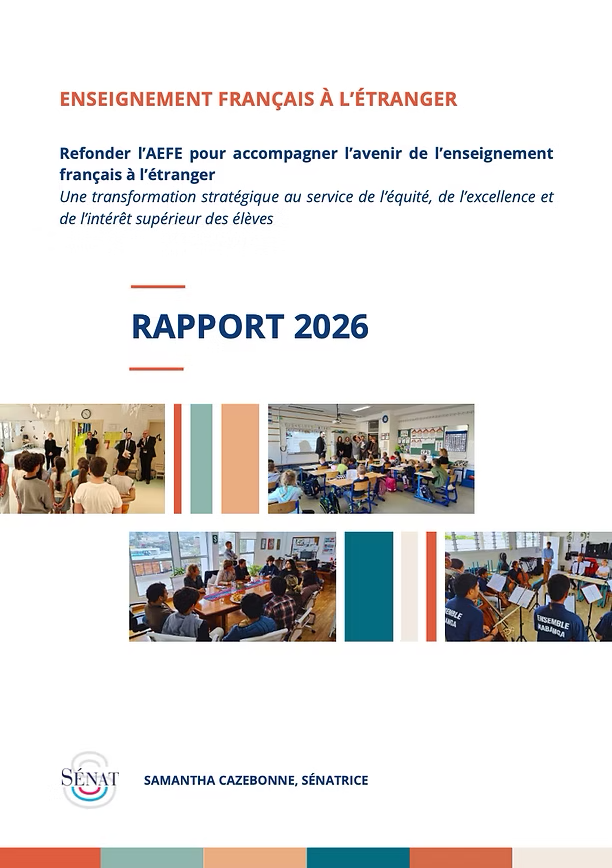
Rapport de la Sénatrice Cazebonne sur la réforme de l’enseignement français à l’étranger
Posted on
Senator Samantha Cazebonne's report offers a sobering assessment of the AEFE's structural difficulties, in particular the growing burden of civil service pensions and the financial pressure on directly-managed establishments (EGD) such as our own.
It does not propose any radical transformation or silver-bullet solution capable of rapidly reversing the sharp rise in school fees seen in recent years at LFCG.
Governance a suggested reorganisation into two divisions (one focused on the management of EGDs, the other on strategy and international development), presented as more agile. This evolution aims to improve oversight without fundamentally overhauling the existing centralised model (Part 3, section 1.4).
Consultation : a repeated call for better consultation of parents and local stakeholders ahead of major decisions, in order to ease the current climate of mistrust. The report acknowledges that the lack of prior consultation has fuelled tensions (Part 1, 2.6 and Part 3)
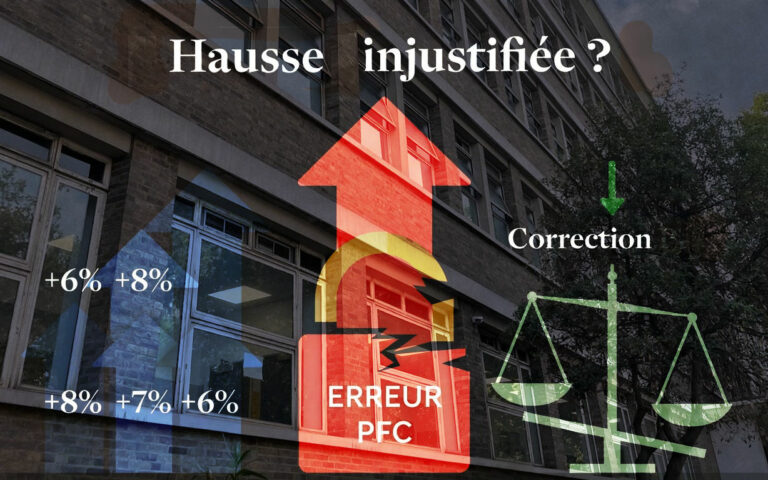
Civil service pensions : a proposal to hold the civil service pension contribution (CPC) at 35% rather than raising it to the planned 50%, and to phase out the supplementary flat-rate contribution (PFC). These avenues are intended to mitigate the transfer of costs onto school fees, but their real scope will depend on future budgetary trade-offs by the French State and the AEFE (Part 5, section 5.1).
Efficiency and transparency : recommendations to introduce analytical accounting (historically absent), to optimise costs, to pool resources and to provide multi-year visibility on public subsidies. The report stresses these levers as a means of demonstrating efficiency gains, without guaranteeing that they will be sufficient to offset the structural imbalances (Parts 2 and 5).
Support for families : avenues for reforming scholarship support directed at middle-class families and providing free schooling for staff children (with estimated savings and a reorientation of benefits). These measures could ease the burden for certain families, but their impact on EGDs such as ours will depend on concrete implementation (Part 5).
At the level of EGDs such as LFCG:
Local autonomy: the possibility of greater latitude in day-to-day management (budget, local contracts, adaptation to the London context), while remaining under the AEFE's strategic oversight. This responds to calls for greater flexibility without calling direct management into question (Part 3).
Role of parents : enhanced involvement of management committees (on which parent representatives sit) in the selection of senior leadership staff. This measure could improve the consideration of local concerns, without however transforming the decision-making weight of families (Part 5, 5.5.2).
Cost containment : the measures on pensions and budgetary efficiency could, if genuinely implemented, contribute modestly to containing future increases, without however guaranteeing any reversal of past rises or resolving the chronic deficit.
In conclusion the report identifies levers that are interesting on paper (transparency, consultation, capping of certain contributions), which broadly point in the direction of reduced pressure on EGD families. However, it remains cautious about the real room for manoeuvre and does not gloss over the persistent budgetary constraints. The concrete impact on our school fees at LFCG will depend largely on political decisions and effective implementation, both of which remain uncertain at this stage.
La séance débute par l’approbation du compte-rendu du précédent Conseil d’Etablissement par les membres du Conseil. Puis sont discutées, selon l’ordre du jour : Mme Shulver (DSL) a présenté les données d’incidents, les formations à venir (ADHD en février, anti-harcèlement), la création d’un comité SEN pour les admissions d’élèves à besoins complexes. Elle a rappelé…
Cet article est publié en priorité pour nos adhérents. Nous l’offrons temporairement à l’ensemble de la communauté du LFCG. Connectez-vous ou Adhérez. Dans l’intérêt de tous les parents du LFCG, nous souhaitons partager ce que nous considérons comme des évolutions préoccupantes adoptées lors du dernier Conseil d’Établissement du 2 juillet 2025. Nous avons demandé des…
Retrouvez ci-dessous la déclaration liminaire lue par le CIPL au CE du 2 juillet dans la défense des intérêts des familles, ainsi qu’un compte rendu rédigé par l’association de la séance. Compte-rendu du Conseil d’Etablissement du 2 juillet 2026
L’AEFE nous fait part de sa réponse par un courrier daté du 30 avril, refusant de revenir sur l’augmentation prévue des frais de scolarité de 2% à la rentrée 2026, en tentant de se justifier via des erreurs factuelles ! Cette lettre est problématique pour plusieurs raisons, et nous y avons répondu par le courrier…
Nous vous invitons à lire la déclaration liminaire lue hier au Conseil d’Etablissement du LFCG.Prenez également connaissances des questions posées par les représentants des parents auxquelles la Direction de l’établissement a refusé de répondre. Madame la Proviseure, Mesdames et Messieurs les membres du Conseil d’établissement, Les familles du Lycée Charles de Gaulle (LFCG) traversent aujourd’hui…
Au delà de notre déclaration liminaire, lors du dernier CE du 9 décembre, vos représentants élus du CIPL ont soumis une liste de questions ayant trait à l’état des finances de l’établissement, concernant notamment la TVA, les avances, et la situation financière des annexes du primaire. (Ces questions sont reproduites au bas de cet article.)…